
By Beata Tsosie
Ecology of Family
Family is chosen, birthed, nurtured, inherited, and ecological.
It is the tiny threads glowing beneath the soil in networks unseen, in energetic connections nurtured throughout lifeways, culture, blood, experience, and spiritual bonds throughout this lifetime and beyond.
Belonging is inherent to existence on this blessed Earth.
We must ask how we would move and love differently as a community—as caregivers, carriers of medicine, advocates, and warriors—if we were clear in our spiritual existence and understood our belonging within a timeless cosmology and shared purpose.
When working with families as a Midwife, Birth worker, Promotora, Doula, Lactation Counselor, Community Health Worker, or Farmer, there is a profound opportunity to nurture connection and belonging in alignment with the values of Place and Indigenous cosmologies.
This work involves weaving connections not only to resources, but also a co-op of community care, a continuance already present both in nature and across land-based, multi-generational regions.
It is a braiding of intention—deeply spiritual in its holding of space and continuance—that honors ecologies and feeds a culture of peace through simple acts of care and advocacy for reproductive experiences. These foundational health networks broaden to hold families from the prenatal years into early childhood.
Natural Systems as Models of Care
We look to natural systems to structure our models of care, beginning with the humility to recognize our purposeful place in nature. We respect the elements and non-human relatives who witnessed humanity’s emergence; they wait for us to communicate, listen, and hear the solutions surrounding us.
Nature functions through multiple, deep connections, and we are an inseparable part of that nature.
Mycelial networks, for instance, are among the most ancient and sustainable organisms, inherently cooperative and collaborative.
They share resources in abundance and live in symbiosis with plant relatives to form webs of communication in forest systems. These networks can detoxify, transform, digest, or translocate pollution and harm; they are essential for transforming death and collapse into rebirth and fertile possibilities.
It was never just "survival of the fittest," but always a culture of cooperation, resource sharing, and the ability to exist in interconnecting spaces abundant with transformational purpose.
When we model our societal systems on these values, we can see how sustainable communities and traditional roles have always carried these values forward to ground us in Spirit and a life-affirming culture.
Below are some examples of how our lifeways and experiences can be supported.
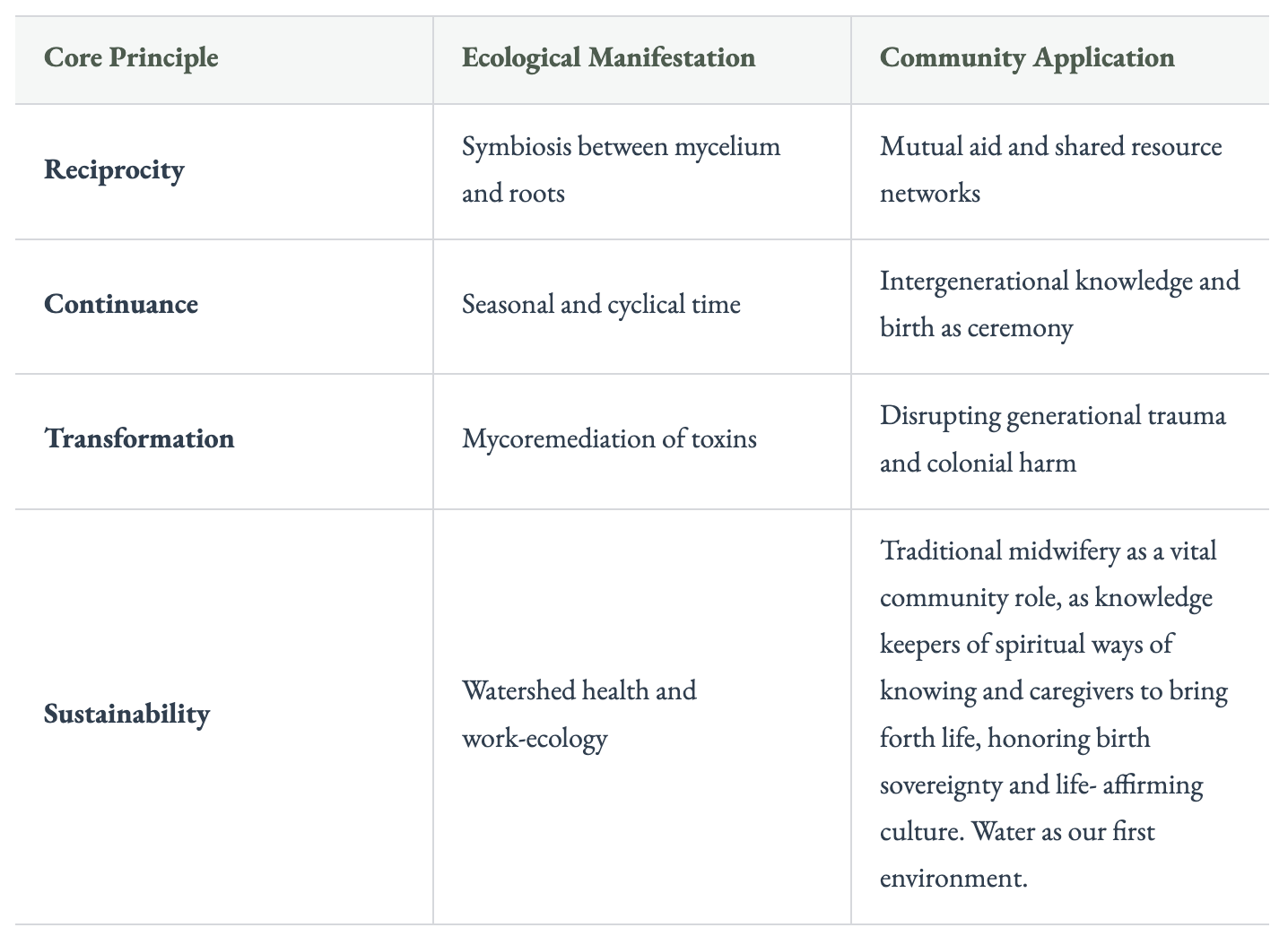
Transforming Harm Through Secure Attachment
Diverse Peoples continue to practice a culture of care modeled after natural systems, existing in collaborative and reciprocal processes. This energy calls us to be helpers, forming the basis for an abundant ecology and economy rooted in care. We focus on the transformation of harm through our ability to "oxygenate" with voices, actions, intentions, and prayers.
Supporting healthy attachment is a crucial way to heal forced colonial disconnection.
Micro-moments with families—noticing, celebrating, and uplifting shared learning, love, and joy—can disrupt harmful patterns and nurture the bond between caregiver and child.
Many families carry deep historical and generational impacts and chronic disconnection rooted in colonial violence. It is a starting point to recognize how systemic harm can begin to become a pattern that disrupts attachment and connection first from our caregivers, then to nature and each other.
We work to create safer pathways and neural "grooves" in familial and individual nervous systems to disrupt these dissociative behaviors and create supportive lived experiences.
Nurturing secure attachment is vital for a baby’s physical, emotional, and social development, impacting brain wellness, self-regulation, and self-esteem. Meeting families where they are in these small moments can collectively shift humanity toward a culture of love, respect, and support.
Birth Story as Spiritual Steppingstone
There is a deep need to be liberated from imposed perspectives of time, death, and birth formed from patriarchal systems of fear and disconnection.
We move instead into transformational spaces of presence and love. While not without pain and loss, this path is profound in its possibilities for resilience and a return to balance. It begins with our first spiritual steppingstone: a birth story that serves as the imprint for a lifetime.
This care extends across the entire lifeway, from a person’s first breath to their last.
Our cultural and ecological sustainability depends on how we hold the emergence of life as a ceremony. There is hope in the collective work and in how we show up for each other, meeting families physically, emotionally, mentally, and spiritually.
Intentional presence in small moments feeds and creates an eternity that can help shift humanity into remembering our original instructions and help create a culture of care, love, respect, and support, so that things will go well for us here in this place.
Beata Tsosie is a member of Kh'a'po Owingeh/Santa Clara Pueblo in Northern NM. She has a background as an educator and in early childhood development, traditional farming, and agriculture, and is a full spectrum birthworker, infant massage instructor, and lactation counselor. She is also certified in Indigenous Sustainable Design (permaculture). She is a passionate advocate for reproductive and environmental health and justice and is involved in several projects working towards the restoration of sustainable Indigenous ecologies. She is a co-founder of Breath of My Heart Birthplace and is the Organizational Director. You can reach Beata at beata@breathofmyheart.org.