Learning and Teaching About the Menstrual Cycle
by Cindy Belardo
Pad. Sticky side down.
Tampon. Scary to insert. Will it get lost inside of me? What if I die of toxic shock syndrome?
Blood on my underwear. Don’t let anyone see at all costs.
Oh god, the cramps. Feeling exhausted and uncomfortable.
Pretend like nothing is happening. Go to class, go to work.
These are some of the thoughts that have surely run through the mind of anyone who has ever had a period. Having a period is something that seems intangible and hidden, because it usually is so rarely talked about.
Why Periods Are Taboo
Most of us know periods have been and continue to be taboo in common society (although there are spaces where it’s getting better). But why is it taboo? I think that question boils down to people’s comfort with their own body.
It’s the same line of questioning around why it can be so awkward to ask, learn and teach about sex. It’s rarely talked about in our homes, schools, society, and pop culture because of a lack of funding, prioritization, or normalization for sex education.
The media has a huge impact on how we approach periods. One example of how this manifests is in the commercials we are shown by menstrual product companies. Think of your typical tampon commercial: the ballerinas are so happy while dancing, and they show how the tampons have this incredible technology worth buying so you’ll never have to worry about leaking. Everything is about being “discreet” and “pocket-sized” so you can easily hide the product away. Movies may mention it as a way to bring a (usually negative) explanation of a woman-identifying character’s mood and decision-making. Further, commercials used blue liquid to demo the absorbency of their tampons and pads until 2011. That was the first time that a red dot was shown on a pad instead of a blue liquid.
Still, these commercials feel disconnected from reality. People are never doubled over in pain or discover blood on their bedsheets or have the period poops. They never show real world situations. It all feels like we are being told to lie and pretend.
The Impact of Period Poverty
The number of menarche (first period) stories I’ve heard about kids thinking they literally have blood cancer, because they lacked the knowledge or conversations beforehand, is heartbreaking. Children don’t deserve to go through this confusion, panic, or shame. This lack of education and understanding about our bodies is part of period poverty. To me, period poverty is not just the lack of access to products, it’s the lack of knowledge of our bodies and thus the lack of autonomy to advocate for ourselves. In this case, knowledge really is power.
Essentially, we’ve been so squeamish about periods that we don’t even want to think about what they are, the natural process of a person’s body cleansing the uterus of blood, endometrium lining, mucous, and cervical and vaginal fluid. Periods can be used as a way to create and sustain life, yet we treat them like they’re dirty and shameful. This happens because both non-menstruating and menstruating folks don’t understand reproductive systems, periods, or sex ed and continue to chalk that lack of understanding with it not being “worth respecting.”
The spouse who doesn’t want to “burden” their non-menstruating partner with the education of their kids about periods. The spouse who says, “I don’t have personal experience with periods, so I wouldn’t know anything about that.”
Let’s not let that be the end of the conversation. It’s high time to stop accepting that lack of understanding. Everybody deserves understanding and respect. Period.
Understanding the Menstrual Cycle
It may seem like there are so many things happening when you are managing the experience of period product changes, period-hormone fluctuations, mood changes, PMS, and cramping, all while going about your day. The body is going through a cycle and it is important to know what is happening, even just at a high level to help understand what your body may need.
To break it down, we can take a look at this chart below to understand that the body is going through a cycle, on average ~28 days, consisting of four main phases. Here’s a look at the menstrual cycle and how it goes through menstruation, the follicular phase, ovulation, and the luteal phase.
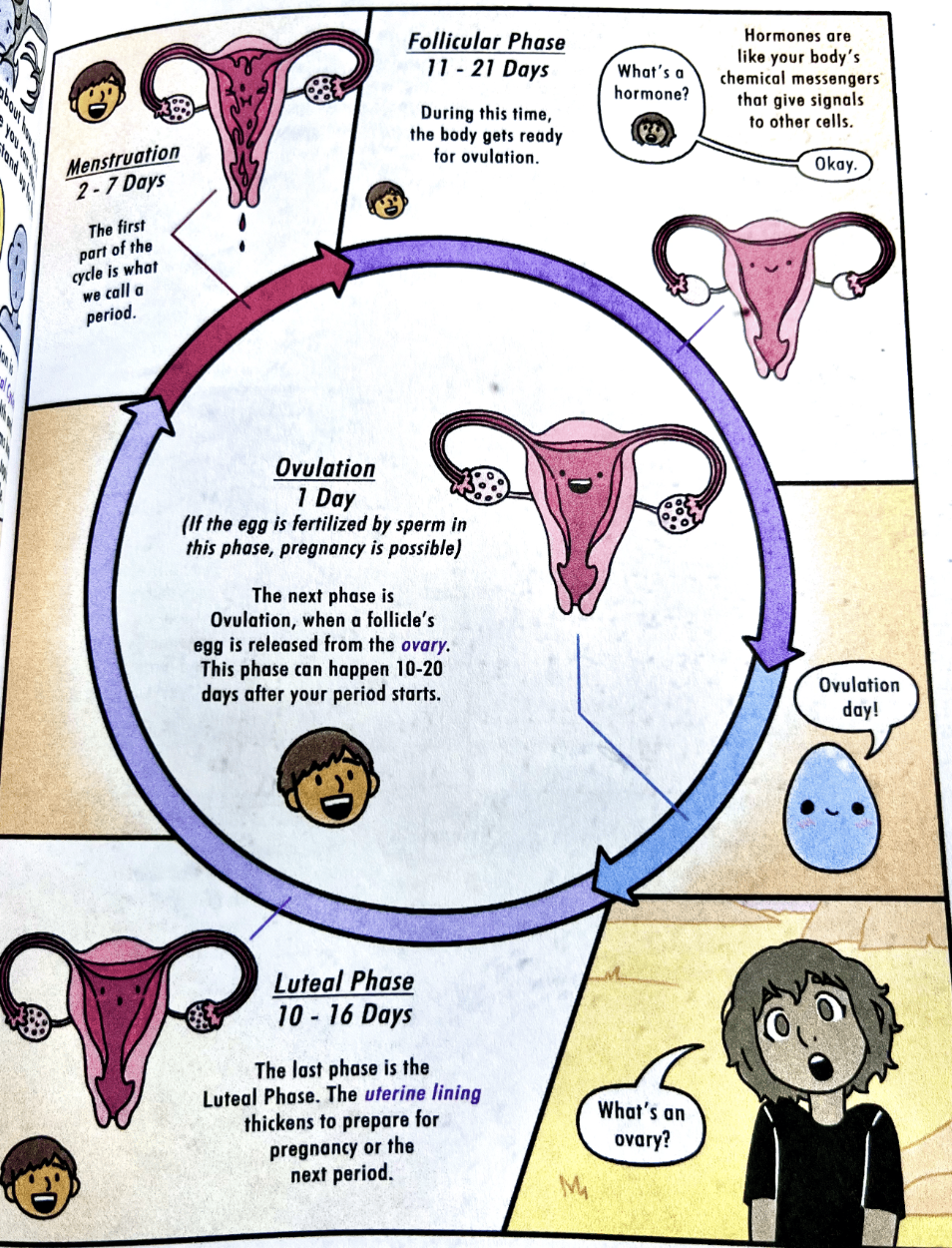
Image from June and the Menstrual Mates: A Young Menstruator’s Journey & Guidebook (page 23).
During the menstrual phase, the body has lower levels of hormones, which can cause one to feel more tired.
In the follicular phase, estrogen levels rise, and you might be able to support your body by eating foods like flax and pumpkin seeds, which support maintenance of estrogen production through ligan and zinc content.
At ovulation, the body releases the egg, and you may have more energy during this time.
During the luteal phase, progesterone is on the rise to support your body to build the uterine lining. Eating foods such as sesame seeds and sunflower seeds may support your body’s production of progesterone in this phase. “Sunflower seeds are rich in vitamin E, and studies suggested that it might increase progesterone levels, the hormone that is essential for maintaining early pregnancy. Due to the presence of high zinc content in sesame seeds, they act as hormone regulators and enhancers, supporting ovulation (Dhamija, et. al).” More research is being done in this area for more natural supportive ways we can take care of our bodies, and it all starts with learning about our cycle.
Creating a More Open Culture
How do we actually have these conversations?
It starts small with honest, everyday conversations at home between parents, kids, and friends, as well as within schools. Sometimes reading a book or a short video can help start a conversation where the family can reflect together. This is the only way to share about what a period is and how menstruators are actually dealing, living, and managing. It’s about so much more than a product. And you don’t need to be perfect. It’s okay to not have all the answers, and it’s okay to make it fun and bring humor in too! Your kids are smart, and they don’t expect you to be perfect.
So many parents, menstruators included, have asked me if I could talk to their kids about periods and sex ed because they are so intimidated about where to start and scared they won’t have the right answer. Seriously. It really shocked me the first time it happened. And it still happens. If you’re struggling with this conversation, know that you’re not alone.
But that just goes to show that the figurative door that is talking about our bodies, our reproductive education, and our feelings around our bodies, has been closed for a long time.
Each family will deal with that door in their own way. Some may cover it up and pretend it’s not there. Others try to open it a little on some topics, like naming body parts and how to use a condom, and then close it back up for other topics like periods or masturbation. I think it really comes down to the caregivers’ comfort with their own bodies. This can make it more difficult to empower others in our lives to be comfortable with their bodies, but it’s not impossible. We can do it scared, acknowledge our feelings in front of others, and do our best with what we have.
A Personal Journey into Reproductive Justice
This was part of my journey into the reproductive justice space. I didn’t realize how badly I needed to try a tampon and a menstrual cup. Not because they are the best product (although, as the cofounder of a period product company, I really do like them a lot). But because they taught me more about my own body. I felt so empowered the day that I was finally able to insert my menstrual cup! I felt so accomplished and proud of myself. And I learned so much about how my cervix, uterus, and vulva work, feel, and look. And it gave me knowledge and appreciation for other bodies who share the same experience, too!
It was this experience that led me to writing my first book, June and the Menstrual Mates: A Menstruator’s Journey and Guidebook. This is a graphic novel that is for kiddos ages 8-12 to read with their parents to learn about their bodies and period care options. It follows the main character, June, through her first period experience and how she magically travels (via a magic cowrie shell–I know, right?) to Ilume to learn about periods from the Menstrual Mates.
One of the most important aspects of the book for me, aside from learning a ton from my friends and colleagues in the process, was that June was curious and used that curiosity to learn about her body and periods. That’s how she learned and defeated the “stigma.” In the end, she had a party celebrating her period education. It’s a vision for a world that we can live in: if we choose to remain curious and open-minded to learning about our own bodies and kids’ experiences, we will see that we are all connected through our common experience of living in a body.
Cindy Belardo, (she/her) has a background in Environmental Studies, Pre-medicine, and Yoga, which has helped her journey to co-create Sunny and Gauz for Life, both dedicated to ending period poverty. Sunny co-creates a vision for a better world through eco-friendly products, honest education and global giveback. Cindy co-invented the only FDA Cleared reusable beginner-friendly period cup and applicator, the Sunny Cup and Applicator, which inserts like a tampon is a TEDx Speaker and author.
Links: @cindyinflow ; @sunnyperiod ; @gauzforlife